Search Engine Optimization is a broad field and affects different areas:
- On-page SEO
- Off-page SEO
- Mobile SEO
- Technical SEO
- Voice Search SEO
The most important SEO tips for On-page website optimisation at a glance – we have ten must-dos for optimising Websites on-site compiled
SEO TIP 1: SECURE CONNECTIONS
It should be ensured that the website is set up for HTTPS. Websites with SSL encryption are now a firm and established standard. If a website does not have SSL encryption, it will be shown to the user as not sure displayed.
HTTPS ensures that no third parties can eavesdrop on the transmission of data, as it is encrypted.
HTTPS is since 2014 a ranking factor with Google. It's only a weakly weighted ranking factor, but we don't build websites for search engines, we build them for our website visitors. And they trust a securely encrypted page more than an insecure website.
As a rule, an SSL certificate can be added at the domain host of your choice.
SEO TIP 2: PAGESPEED OPTIMISATION
The speed at which content loads is very important for the user and therefore also a factor for Google rankings. This is because if content loads too slowly, the bounce rate automatically increases.
Websites with long dwell times, where visitors browse content for an extended period and delve deeper into the webpages, obviously have relevant Content for the user to find the answers to their questions right there.
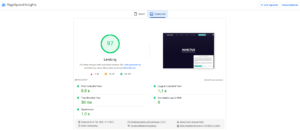
For improving web speed, Google has a tool called „PageSpeed Insights“ has been developed. This practical tool gives your website a score and provides you with immediately applicable tips for improving the performance of your website.
Google loves this and rewards the website with a better ranking.
SEO TIP 3: MOBILE DISPLAY
The fact that more and more users are making their search queries via mobile devices is no news.
This is why it has become absolute standard in 2020 to create websites with responsive design. More and more agencies are starting the development of internet presences with the mobile view, the so-called „mobile-first“Concept, only then does the web design for desktop devices follow.
For the creation of B2B websites, we start with the desktop view, as B2B customers use mobile devices to search for products or services more than laptops or PCs. In the B2C segment, it's the opposite, with more and more end customers searching for content via mobile smartphones and tablets.
This means the content remains the same, but is adapted to the end device in terms of size and display.

Project: First Aid School Berlin
SEO TIP 4: SHORT CLICK PATHS
Websites must be designed to be user-friendly and content must be quickly accessible.
Click paths that are too long lead to drop-offs. If a website has a clean information architecture, this has a positive effect on search engine results.
SEO TIP 5: UNIQUE URL
URLs should always consist of readable words and, ideally, main keywords.
If the URL already contains the most important keyword - the product, the brand or the company name - the website has the best chance of being found by the customer, as Google favours these pages in the top positions.
Users should be able to guess approximately what awaits them on the website by the name; experts also call this speaking URLs.
SEO TIP 6: OPTIMISE TITLE TAGS
The title tag is part of the header information of the website and is a relevant on-page SEO factor.
Google evaluates it and displays it as the title in the search results.
However, it is not only displayed there, but also in the Google snippet or the browser tab, and social networks also use these title tags.
Why the title tag is important for Google – If the heading matches the search query, this increases the Clickthrough Rate (CTR). The CTR is an important factor for Google to evaluate the relevance of your website.
SEO TIP 7: OPTIMISE META DESCRIPTIONS
The meta descriptions are not visible to the user on the website.
They are displayed in the source code or in the Google search results. Although Google does not evaluate these, they influence user behaviour and contribute to click generation, which in turn has a positive effect on organic visibility.
Lately, Google has often ignored meta descriptions and selects the most relevant snippets from the article itself. However, optimising the meta description doesn't do any harm, and since it's a small effort, you should still do it.
SEO TIP 8: OPTIMISE HEADINGS
In heading creation, there is a hierarchy from H1 to H6.
The most significant heading comes in H1 and the least important in H6. It should be noted that only as many levels should be used as make sense for the text element.
Additionally, the headings should be consistent with the title tag and meta description, and also include keywords.
One can assume that Google will perceive a website that wildly mixes up the heading hierarchy, for example, starting with H6 and then using H2, as unstructured.
SEO TIP 9: EDITORIAL CONTENT WITH ADDED VALUE
Google always aims to suggest the most relevant content to searchers so that users continue to use the search engine – and has had time since the dawn of the internet to optimise this process. Alternative search engines like Bing simply cannot keep up in this regard, although the search there isn't bad, it never exactly hits the searcher's intent, the way Google does.
As Google is primarily a text-based search engine, the content should be as unique as possible.
It is important to note: Keyword density is not the decisive factor! While the text should contain keywords, the absolute priority is to offer the reader added value.
He wants to find the right content for his needs.
At best, this will keep them on the webpage for a long time and lead them to a conversion: filling in the contact form, completing the purchase, downloading a white paper, installing an app, etc.
High-quality content leads to successful lead generation.
SEO TIP 10: KEYWORDS FOR IMAGES
Even though, as already mentioned in Tip 9, Google is a text-based search engine, the naming of images should not be overlooked. Since Google displays its own ranking for images, images should be provided with the correct keywords.
Relevance also counts here in order to provide the user with added value. In the context of accessible web content presentation, reading out images is paramount; the alt tag must not be omitted for images.
Conclusion
This article covers the absolute basic SEO tips – if you want to delve deeper into the topic of SEO, then speak to us.
The experts at Invictus look back on almost 20 years of experience in online marketing and search engine optimisation.