„Bake SEO into the product“ is more than just a catchy slogan. To rank at the top of Google with your content, you first need a well-thought-out SEO strategy. A successful SEO strategy should be integrated into every marketing concept from the outset.
Was ist eine SEO-Strategie?
SEO (from English „Search Engine Optimization“) translates to Suchmaschinenoptimierung. Suchmaschinenoptimierung is a major component of online marketing and includes all activities aimed at increasing the visibility of websites in common search engines like Google, Bing, etc.
The goal of SEO is to rank a webpage higher in search rankings.
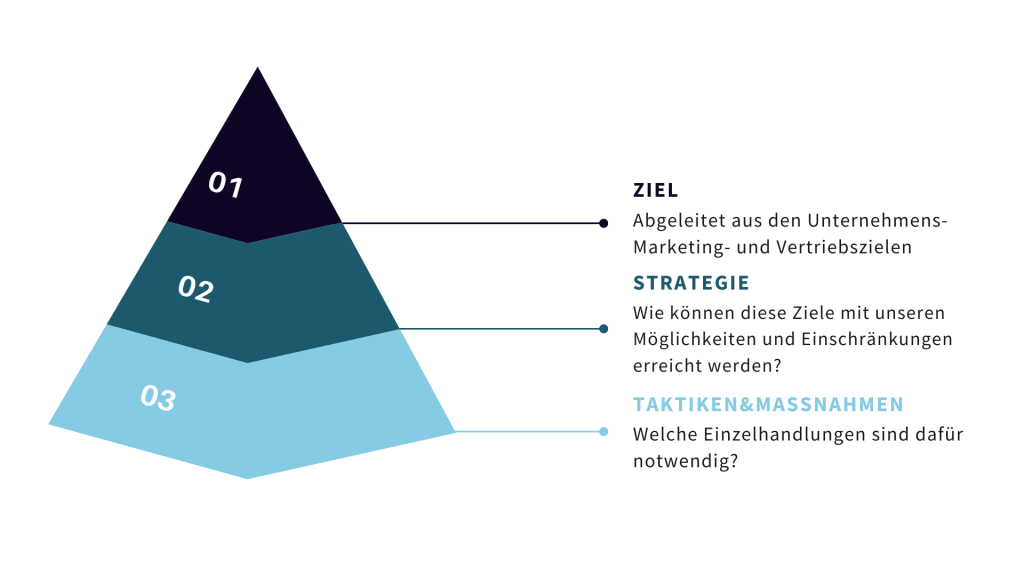
An SEO strategy is a guide that leads to individual goals within one's own measures. The SEO strategy serves as the basis for an operational level and is unavoidable. It consists of three essential elements:
- The analysis, drafting, and prioritisation of SEO objectives
- the planning and implementation of suitable SEO measures and
- continuous performance monitoring and reporting
One should always be aware that an SEO strategy is never completely finished or even finally defined, as search engines, like Google, are constantly evolving. Therefore, the guide must be regularly optimised and adapted.
Why is SEO so important?
Reasons why SEO is so important:
Customer acquisition
SEO ensures your website's visibility and an increase in visitor numbers. Additionally, SEO optimises the content on the website. This guarantees a better website rating from the search engine, making it easier for users to find the website.
Qualified visitors
Internet users already indicate what they want through their search queries. Now, they just need to be convinced of the product by presenting the right product in the search results. This is where keywords come into play. Keywords are crucial for your website to appear to users when they enter these key terms. This way, we can reach as many people as possible who are interested in our service or product.
Sustainability
An optimised website ensures long-term success. SEO is more cost-effective than paying monthly for advertising placements. Advertisements disappear as soon as no budget is deposited. An optimised website remains. Quality content on the website can bring high-quality traffic to the website for years to come.
Cost-effectiveness
SEO explicitly targets users who are already interested in the product or service. Thus, search engine optimisation is a cost-effective marketing measure.
Brand awareness
With professional website optimisation, SEO will take your brand far. If your website is listed within the top ten search results, it will both increase the reach of your product or service and build trust with potential customers.
Profit for all marketing activities
A key component of search engine optimisation is the user-friendliness of your website. Good usability also benefits other marketing measures, as users will discover your website through your advertisements and social media posts. Particularly with advertisements, we aim to sell our products. However, if the user cannot navigate your site and abandons their purchase, you will still have paid for the click.
Creating a successful SEO strategy in a few steps
The goal of this process is to develop a successful and sustainable SEO strategy.
The following steps are relevant for building a successful SEO strategy for the website:
- Target Audience Analysis
- Competitor analysis
- Content and keyword strategy
- Analysis and SEO Audit
- SEO measures
- Monitoring, Reporting and Optimisation
Target group analysis
The target group analysis is the basis for all further procedures. It is an important tool for gaining a better understanding of one's own target group and their needs, lifestyles, and purchasing motives, in order to develop relevant content and marketing measures tailored to customers on that basis. Target group analysis is a continuous process and should be carried out regularly.
2) Competitor analysis
Competitive analysis focuses on the strengths and weaknesses of competitors. The aim is to better assess the company's own position, in order to subsequently identify targeted measures for improvement in the market.
- What are the strengths and weaknesses of your own company?
- What are the strengths and weaknesses of the competitors?
- Where do customers see the strengths and weaknesses of our company in comparison to the competition?
3) Content and keyword strategy
A keyword strategy focuses on the content that should become visible to users at the right time. To achieve this, keyword research must first be carried out. The goal is to find the relevant keywords with the highest search volume. The higher the search volume of a keyword, the more often it is searched for on average per month. Therefore, it is all the more important to know which terms the target group uses and which keywords the content should be optimised for.
For keyword research, we recommend SEO tools such as Semrush and Seobility, but Google's own tools, such as Google Search Console, Google Keyword Planner, Google Suggest, or Google Trends, can also be used to research relevant keywords for your content.
4) Analysis and SEO Audit
To professionally and correctly complete SEO implementation and planning, an audit of the current website and SEO performance should be carried out.
An overview of the most important SEO analyses:
- __OPENROUTER_FAILED__ How is the website's performance in organic search? How have clicks, ranking position, and impressions changed over time? What are the best and worst performing URLs?
- SEO audit Here, both the ranking and existing content are analysed. It is determined which goals have been achieved so far. Problem areas can be identified here and, based on this, action plans for the next steps.
5) SEO measures
SEO success is data-driven. SEO measures that are defined and prioritised based on conducted analyses lead to greater visibility, better ranking positions, and consequently more users and potential customers in the long term.
SEO measures include, among others:
- On-page SEO
- Off-page SEO
- Technical SEO
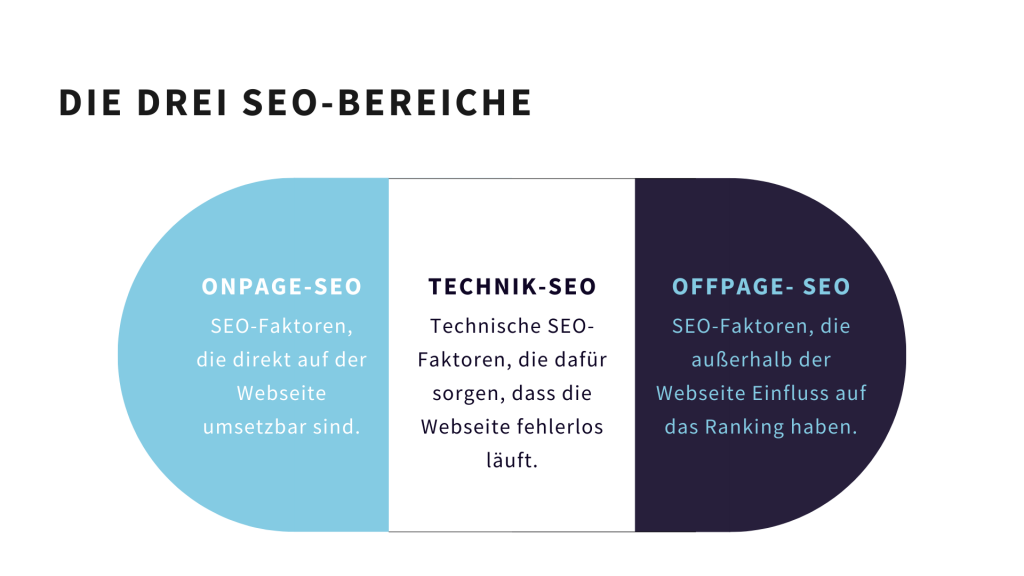
On-page SEO all optimising measures taken directly on a website. This includes, on the one hand, the keyword optimisation of all SEO-relevant content: title tags and meta descriptions, text, headings, URLs, alternative text for images. On the other hand, content should be prepared based on user search intent. This ensures better rankings and traffic, as well as clicks and conversions.
Internal linking is another essential task in on-page SEO to make content accessible to the search engine and users.
In summary, the following on-page SEO measures should be included in the SEO strategy:
- Keyword and content optimisation: Metadata (Title Tags and Meta Descriptions), Headings, Text, Images (Alt text, File size), URLs etc.
- Optimisation of internal linking Accessibility of all content, keyword optimisation of link text, linking of all relevant pages in the navigation, linking to further content, etc.
For the successful implementation of an SEO strategy, a second important building block is technical search engine optimisation. This concerns the technical foundation of a website. It is also the basic requirement for all further SEO measures, as the crawlability and indexing of content are ensured.
Checklist for Technical SEO:
- Planning the website structure (for new websites)
- Ensuring website crawlability
- Ensuring website indexing
- Usage of HTTPS
- Ensuring that the website is accessible under a domain
- Fast web page loading
- Ensuring the website is mobile-friendly
- Installation of an image compression plugin for improved page speed
- Repair broken pages
- Resolving duplicate content
Off-page SEO is a part of search engine optimisation and is the counterpart to on-page optimisation. It summarises all SEO measures that happen outside one's own website and are used for link building.
Some SEO measures you can use in 2022 to build organic traffic with high-quality backlinks:
- Brand building
- Content Marketing
- Setting up mentions
- social media
- Linkbuilding
- Brand building
- PR
- Influencer Marketing
- Events
- Reviews
- Podcasts
Off-page SEO can be seen as the authority of one's own website. Without it, the website would not be able to overtake other websites that have higher authority in the rankings.
Linkbuilding
Link building aims to get a website as many backlinks as possible from high-quality pages. Search engines like Google prefer it when backlinks to a website build up organically, as it offers high-quality content and users link to it voluntarily.
However, not all backlinks are created equal: search engines analyse and evaluate the strength of a link using various factors such as the link's position, the link text, the number of links from a source, and most importantly, the strength of the linking website. Therefore, backlinks still appear to be an important ranking criterion for Google.
6) Monitoring, Reporting and Optimisation
SEO is a continuous cycle of planning measures, monitoring, and optimising measures. For this purpose, it is important to keep an eye on the key figures regularly. These key figures are used on the one hand to measure SEO success and on the other hand to facilitate the analysis of SEO problems.
First and foremost, you should focus on these SEO metrics:
- Visibility: __OPENROUTER_FAILED__
- Keyword Monitoring Ranking position of individual keywords, development of keyword segments, rising and falling rankings, number of keyword cannibalisations
- Traffic monitoring Organic traffic in general, as well as traffic from individual content clusters, impressions, clicks, conversions (from organic traffic)
- Technical Monitoring Core Web Vitals, Pagespeed, Mobile Experience, Status Codes, Canonicals, Meta Tags, Hreflang
A goal-based SEO Monitoring and Reporting helps to continuously improve the website.